
Winter is a time for rest, relaxation, and some much needed downtime. Days are shorter, people are stuck inside, and any excuse to leave the house begins to feel like a joyous occasion.
But, as life slows down in the winter, something else is on the rise (and it’s not the temperature). That something is weather-related accidents.
Winter presents volatile driving hazards that are completely unique to the season. If you approach driving this winter like any other season, you could be in for a world of trouble.
In this blog, we’ll run through some essential driving tips so you can be safe and responsible behind the wheel, all winter long.
Before You Hit the Road
Clear all snow and ice off of your car
Be sure to completely remove all snow and ice from your ride before you take to the streets. Areas you want to be particularly careful about removing snow include windows, mirrors, lights, plates, and your roof.
Letting snow fall off your car and onto the road is a hazard to yourself and other drivers. Outside of the obvious safety reasons for this precaution, it’s also the law. Failing to clear your car before you start driving can result in a fine of $100.
Check tires, brakes, wiper blades, battery life, and fluid levels
Prior to commencing cold weather commuting, it’s always a good idea to do some basic winter vehicle maintenance. This includes checking:
- Tires
- Brakes
- Batteries
- Wipers
- Wiper Fluid
Servicing your car in mid to late autumn is a very wise way to approach winter driving. And while you can check all of these things on your own, many mechanics offer winterization services for those of us who are less mechanically inclined.
Use winter-rated windshield washer fluid
With regard to windshield wiper fluid, make sure you’ve got the right stuff! Standard wiper fluid will freeze instantly in temperatures below 32 degrees. This becomes a major hazard in the winter when drivers are forced to constantly spray their windshields to combat salt accumulation.
To be on the safe side, make sure you fill your reservoir with winter-rated, anti-freeze wiper fluid. This will ensure your wipers are effective all winter long.
Use winter-rated tires
Related to winter-rated wiper fluid, using winter-tires is an absolute pro-move for winter driving in Michigan. Winter tires are made with specialized rubber that stays soft and grippy below 45 degrees. They’ll allow for improved traction, better handling, and reduced braking distance. If you can afford them, driving with winter tires is a no-brainer!
Have emergency supplies in the car
As a final bit of preparation for winter driving, creating an emergency supply kit is an excellent precaution. Although this could go unused, it will absolutely come in handy when disaster strikes. Items to add to your emergency supply kit include:
- Warmth (extra blankets and clothes)
- Visibility (flashlight, flares, etc.)
- A windshield scraper
- Traction (sand or cat litter)
- Power (Portable phone charger and/or a portable jumpstarter)
- Jumper cables
- A First aid kit
- A Multi tool
- A snow shovel
- Food and water
These items are all ultra-practical and can easily be fit in your trunk. Creating a kit with similar contents could save you this winter – you never know.
Behind the Wheel
Drive slow on ice and snow
Snow and ice drastically hinder your handling and ability to brake. Stopping hard on ice can increase your braking distance by 5-10 times compared to dry pavement.
In order to avoid slipping and sliding, make sure you’re mindful of your speed in the winter. Reducing your speed by half is a good general guideline for driving on snow. If you’re dealing with ice, speeds as slow as 5mph could be required to stay safe.
Increase following distance
While it’s never good driving etiquette to tailgate someone, this is especially true in the winter time. Increased stopping distance and limited handling ability makes it super important to leave ample room between you and the car in front of you. Failing to do so can quickly lead to sudden spinouts and nasty rear-end accidents. A good rule of thumb is to leave at least 8-10 seconds between you and the next car ahead.
Use low-beam headlights in snow
Instinctually, many of us switch to our high-beam headlights when we encounter reduced visibility (like in the dead of night). Although this can help when it’s dark, it will actually hinder your ability to see when it’s snowing.
White snow is a strong reflector of light. Paired with high-beam headlights, you can quickly blind yourself in heavy snow. It’s best practice to always use your low-beam headlights if it’s snowing and to consider pulling over if your vision is seriously compromised.
Avoid cruise control on winter roads
Cruise control is great for long, predictable stretches of highway. Unfortunately when it snows, highways are anything but predictable. Ice, slush, salt-spray, and hidden potholes all contribute to a volatile driving environment during our formidable Michigan winters.
While it may feel routine to throw your car into cruise control on your daily commute, avoid doing so if the roads are slick. Losing traction is bad enough under normal winter driving circumstances, but when cruise control is on there’s almost no hope for regaining control. If you know roads are slick, don’t use cruise control.
Snowplow Etiquette
Snowplows are a vital part of our state’s infrastructure. Without them, we’d be confined to our homes all winter long.
As important as snowplows are to our daily lives, many of us have never been instructed on how to react if we encounter a winter service vehicle on the road. Unsurprisingly, many accidents happen as the result of improper etiquette around these large trucks.
Snowplows often stop sporadically and unpredictably. A safe baseline is to leave at least 6-10 car lengths between your vehicle and any trucks moving snow. That gives you more than enough time to react if needed.
Similarly, remember not to pass snowplows. They’re large, heavy, and equipped with sharp blades all around. Passing one is a bad idea, even on the left-hand side. It’s best to remain patient and wait for them to clear the way.
If you encounter a stopped snowplow, be sure to reduce speed and merge into an open lane if traffic allows. It’s not just the courteous thing to do, it’s the law.
If Things Go South
Slow down and stay calm
As discussed in the previous blog on hazardous winter driving scenarios, there are countless ways you can lose control of your car in the winter. Whether it’s ice or an unexpected whiteout, wipeouts are inevitable if you aren’t careful.
If you feel yourself starting to slide or lose control on an icy road, the key is to remain calm. Trying to accelerate or over-correct will only make things worse. To have the best chance at regaining control, you should:
- Stop accelerating: Take your foot off the gas.
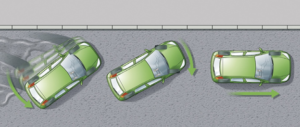
- Avoid sudden turns: Don’t try to correct once you start sliding. Instead, steer slightly towards the direction that the back end of your vehicle is starting to slide (see diagram below).
And with regard to brake application:
- If you have ABS: Apply steady pressure and let your ABS do its thing.
- If you don’t have ABS: Pump your brakes gently (to avoid locking your wheels).
By remaining calm and following these recommendations, you’ll have the best shot at avoiding a sliding crash.
If you must stop, pull fully off the road
Driving with reduced visibility is dangerous, especially when it’s snowing. While it’s possible to slowly crawl your way through a storm, there are times when it’s downright irresponsible to do so.
Sudden whiteout conditions are a time when even the most experienced drivers might benefit from stopping and letting the weather pass by. While this seems like straightforward advice, you have to remember not to stop where your vehicle is a hazard to others. Places you can stop and wait for the weather to subside include:
- Parking lots
- Rest areas
- Highway shoulders (completely off the highway, with your hazards on) (only if absolutely necessary)
Places to avoid stopping (which should be rather obvious) include:
- In the middle of roadways
- On private property (like someone’s yard)
You can’t always plan for whiteout conditions, but by following these steps you’ll be safe stopping during a serious, visibility-reducing storm.
Call authorities
If you find yourself stuck, broken down, or are stopped waiting for the weather to subside this winter, calling the police is a smart move. Michigan State Police and local law enforcement are trained to respond to winter road conditions and can help direct traffic, assess safety risks, and coordinate assistance when needed.
One of the main reasons to call the police is to prevent secondary accidents from taking place. This is especially true if you’re stopped near a busy roadway or if visibility is extremely low (as discussed in the previous section). Police can quickly and effectively alert other drivers of your presence and ensure you aren’t a hazard to anyone else on the road.
In addition to alerting others, police can help get you unstuck or call a tow service if need be. While it’s not always necessary to contact the police during an emergency winter driving situation, having trained professionals present is never a bad idea and often prevents a bad situation from getting much worse.
Get David Get Paid
Winter happens fast. Winter accidents happen even faster.
If you’re in a wreck this winter, make sure you have a winning legal team on your side. Make sure you have Femminineo Law.
We’ve been dealing with winter-weather related accidents for over 30 years. From whiteout pile-ups to black ice spinouts, we’ve seen them all. We’ll guide you carefully from day one and ensure that not even a single cent of compensation is left on the table.
Give us a call at 855-65-CRASH and experience the Femminineo Law difference today!